Why AI Projects in RFQ and CPQ Fail
Over the past two years, AI has become one of the hottest topics in industrial sales. Vendors promise faster quote preparation, automated RFQ processing, intelligent product selection, and significant productivity gains for commercial and engineering teams.
Yet many AI initiatives fail to deliver the expected business outcomes. The problem is rarely the technology itself. More often, organizations attempt to automate processes that were never ready for automation in the first place.
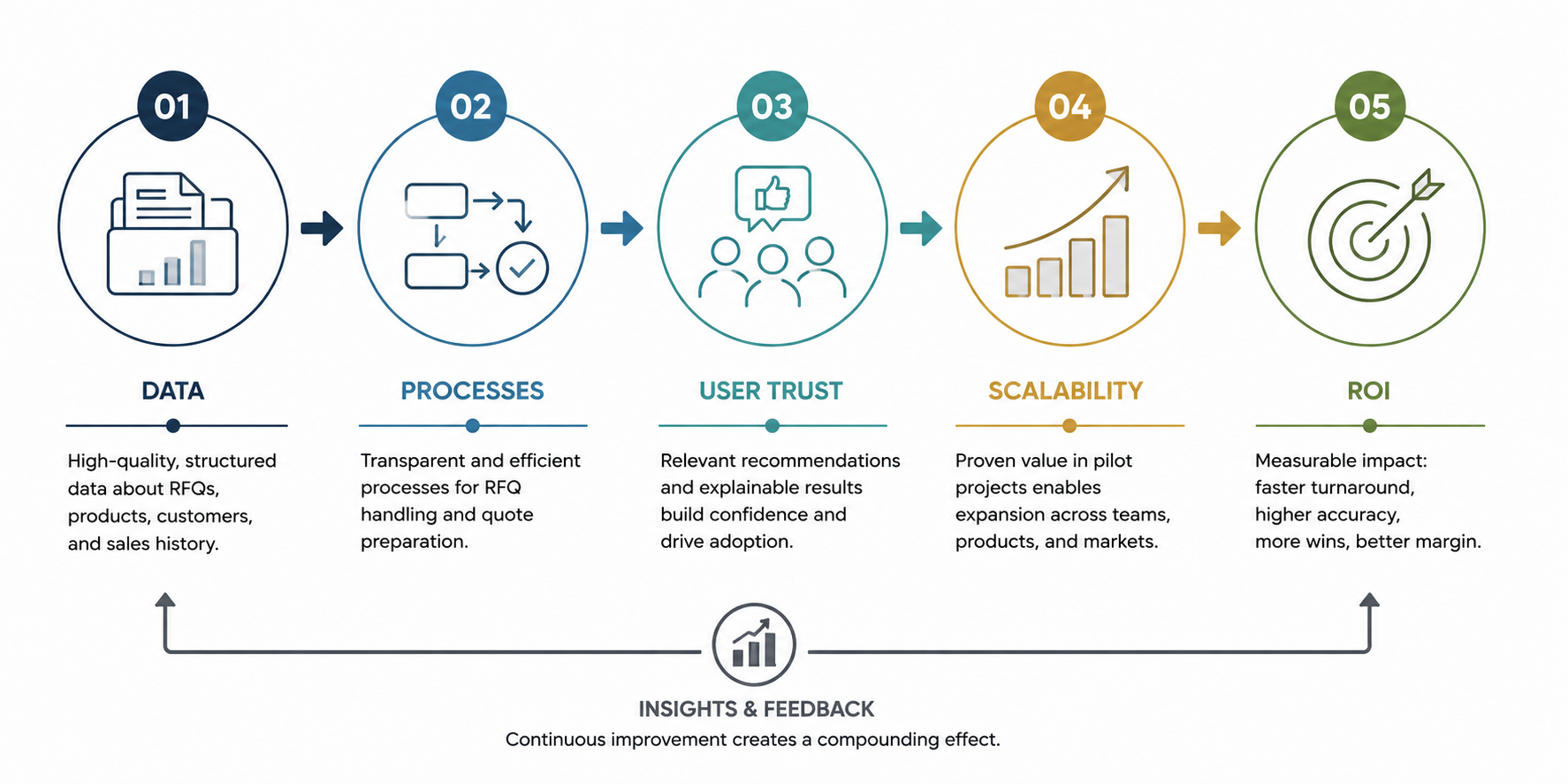
In many manufacturing and engineering companies, preparing a quotation remains a highly manual activity. RFQs arrive through email in multiple formats. Technical specifications are scattered across PDFs, spreadsheets, drawings, and shared folders. Product knowledge is distributed between ERP systems, CRM platforms, engineering databases, and the personal experience of key employees.
In such environments, AI does not eliminate inefficiencies. It simply accelerates them.
Starting with Technology Instead of Business Problems
One of the most common mistakes is beginning with the question: “How can we use AI?” A better question is: “Which business problem are we trying to solve?”
Are quotation cycles too long? Are engineering resources overloaded? Are commercial teams losing opportunities because responses take too long? Are errors in specifications creating unnecessary costs? Without a clearly defined business objective, AI becomes a technology experiment rather than a business initiative.
The Missing ROI Conversation
Many companies struggle to quantify the true cost of their quotation process. They often do not know how much it costs to process one RFQ, how many engineering hours are spent preparing quotations, what quotation errors cost, or how much revenue is lost due to slow response times.
Without baseline metrics, it becomes nearly impossible to evaluate the economic impact of an AI initiative. Every successful transformation begins with a clear understanding of the current process and its associated costs.
Data Quality Remains the Largest Barrier
Data quality continues to be one of the most significant obstacles to successful AI adoption in sales organizations. This challenge is particularly visible in industrial environments.
Preparing a quotation often requires combining information from customer specifications, product catalogs, engineering standards, historical projects, supplier pricing, and commercial policies. If this information is fragmented, inconsistent, or poorly structured, AI systems will struggle to produce reliable recommendations.
The competitive advantage of the next decade will not come from purchasing the latest AI platform. It will come from owning the highest-quality operational data.
User Trust Matters More Than Model Accuracy
Technology adoption is ultimately a human challenge. Even a highly accurate AI solution creates little value if commercial and engineering teams do not trust its recommendations.
In industrial sales, mistakes can be expensive. An incorrect configuration, an overlooked requirement, or a pricing error can result in lost contracts, margin erosion, or costly rework. As a result, explainability often matters as much as accuracy.
Trying to Automate Everything at Once
Another common reason for failure is excessive ambition. Organizations frequently attempt to transform the entire quote-to-order process in a single initiative.
What begins as a well-defined project gradually expands into a multi-year transformation program involving dozens of stakeholders, competing priorities, and increasing budgets. The most successful implementations usually start smaller: RFQ classification, document extraction, specification analysis, or quote draft generation.
Automating Broken Processes
AI should not simply replicate existing workflows. It should challenge them. Many organizations digitize inefficient processes without questioning whether those processes still make sense.
The greatest benefits emerge when AI becomes a catalyst for process redesign. Organizations should use implementation projects as an opportunity to rethink responsibilities, approval flows, information management, and customer engagement models.
The Architecture Challenge
Many companies deploy AI tools independently across departments: a chatbot here, a document-processing platform there, a separate search assistant somewhere else. Over time, this creates another layer of fragmented technology that becomes difficult to maintain, integrate, and govern.
Without a coherent architecture for data, processes, and systems, AI can increase complexity rather than reduce it. Successful organizations treat AI as part of a broader operating model rather than a collection of isolated tools.
Looking Beyond Chatbots
The future of industrial sales is unlikely to be defined by chatbots. The next wave will be agentic systems capable of autonomously analyzing RFQs, extracting requirements from technical documentation, identifying relevant products, preparing quotation drafts, and coordinating internal workflows.
However, the effectiveness of such systems will not depend primarily on the sophistication of the model. It will depend on the quality of the underlying processes and data.
AI amplifies what already exists inside an organization. When processes are efficient and data is structured, AI accelerates growth. When processes are fragmented and data is unreliable, AI accelerates chaos.
The Question for Business Leaders
The critical question is not: “How do we implement AI?” The more important question is: “Are our processes and data ready for AI to create measurable business value?”
Sources
McKinsey & Company — The State of AI: mckinsey.com
Salesforce — State of Sales: salesforce.com
Need help evaluating RFQ automation opportunities?
We help manufacturers and system integrators identify where RFQ-to-Quote automation can create measurable business value.